XPA-RPA
Interactions
(literature search)
Summary References Sequence Structure
|
RPA residues |
XPA binding site |
Specific Reference |
|
RPA34C |
XPA (1-58) |
Li (Oct ’95) |
|
XPA (29-46) |
Bochkareva (Oct ’00) |
|
|
UNG2 (73-88)≡XPA (29-46) |
Bochkareva (Oct ’00) |
|
|
RAD52 (257-274)≡XPA (20-46) |
Bochkareva (Oct ’00) |
|
|
UNG1 (57-79)≡XPA (20-46) |
Krokan (Mar ’97) |
|
|
XPA (4-29) |
Tanaka (Dec ’96) |
|
|
RPA70 |
XPA (153-176) |
Li
(Oct.’95) |
|
RPA70 |
XPA (102-129) Zn domain |
Tanaka (Aug ’98) |
|
RPA70 N/C |
XPA (138-182) |
Tanaka (Aug ’98) |
|
RPA70-SSB1 (183-296) |
XPA-MBD (98-219) |
Lowry (Jul ’03) |
|
RPA70 |
XPA-MBD |
Bochkareva (Oct ’00) |
A. Information on specific interaction
sites
1. Li et al. – Interactions sites on XPA.
XPA (153 to 176) contains domain for interaction with RPA70. This domain consists of three motifs just downstream the zinc finger motif. First 58 amino acid residues of XPA bind to RPA34. (Top)
RPA34 C-term is the XPA interaction domain. (Top)
XPA (4-29) interacts with RPA34 and XPA (98-187) interacts with RPA70. Simply, N-term of XPA & C-term of XPA interacts with RPA34 & RPA70 respectively. (Top)
UNG1 gene is homologous to XPA. UNG1 has an N-terminal pre-sequence which contains a region of 23 amino acids very similar to RPA34 binding domain of XPA. It was found that binding of RPA34 to UNG1 was dependent on the pre-sequence. C-term of RPA34 from 136 to 271 is sufficient for binding to UNG1. Residues 57-79 in UNG1 and 20-46 in XPA interact with RPA34. (Top)
C-term of RPA34 is the primary interaction domain for XPA. Interaction of RPA with XPA does not require phosphorylation of RPA and can occur in the absence of DNA. (Top)
RPA70 is more
involved in binding to XPA than RPA34. Zinc containing domain of XPA (102-129)
is a binding domain for RPA70. C-term of XPA consists of a sheet-helix-loop
region (138-182) which could bind with the N or C-term regions of RPA70. [C-term of XPA contains a cleft contributed
by well-conserved Lys141, Lys145, Lys151, Lys179, Lys207 & Arg207. This
cleft and surrounding area interact with DNA]. (Top)
C-term of RPA32
interacts with N-term of XPA. XPA 29-46 is sufficient for binding to RPA32.
Direct interaction between DNA binding domains of XPA and RPA70 is suggested. [Sequences UNG2 (73-88), XPA (29-46) &
RAD52 (257-274) interact with RPA32 in similar fashion . This kind of sequence
may bias peptides toward helical conformations and thereby facilitate their
interaction with RPA32C. N-term of RPA32 is not required for formation of
complex with UNG2. Lys78, Arg84, Arg73, Arg76 & Arg88 of UNG2 are involved.
Presence of flexible N-term suggests that RPA32C is an independent module that
does not contact adjacent regions of RPA.] (Top)
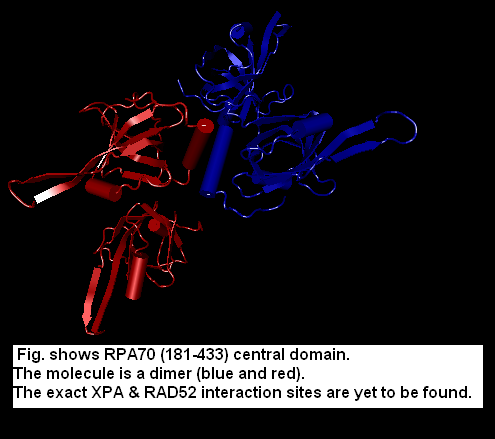
It is shown that the minimal fragment of XPA (XPA-MBD: 98-219) necessary for DNA binding has an interaction with SSB1 (183-296) from RPA70. Also, the XPA-MBD-binding interface overlaps the ssDNA-binding interface on the surface of SSB1. It is possible that the observed interaction between RPA70 and XPA-MBD is too weak to be physiologically relevant. However, the observation that ssDNA and XPA-MBD compete for an overlapping site in RPA70 is consistent. (Top)
B.
General interaction information
C. Other papers covered:
1. Wyman et al.
2. Aboussekhra et al.
3. Sancar et al.
4. Tanaka (Mar. 1999) et al.
5. Naegeli et al.
6. Krauss (Aug. 1999) et al.
7. Krauss (Mar 2001) et al.
8. Wood et al.
9. Lee (Aug 2001) et al. (Top)
Pending:
1. Turchi – ELSEVIER.
2. Shirakawa - ELSEVIER.
1. Source: NP_000371 – XPA on NCBI protein sequence database [gi: 4507937].
1 MAAADGALPE AAALEQPAEL PASVRASIER KRQRALMLRQ
ARLAARPYSA TAAAATGGMA
61 NVKAAPKIID TGGGFILEEE EEEEQKIGKV VHQPGPVMEF
DYVICEECGK EFMDSYLMNH
121 FDLPTCDNCR
DADDKHKLIT KTEAKQEYLL KDCDLEKREP PLKFIVKKNP HHSQWGDMKL
181 YLKLQIVKRS LEVWGSQEAL
EEAKEVRQEN REKMKQKKFD KKVKELRRAV RSSVWKRETI
241 VHQHEYGPEE
NLEDDMYRKT CTMCGHELTY EKM
2. Source: NP_003353 – UNG1 on NCBI protein sequence database [gi: 6224979].
1 MGVFCLGPWG LGRKLRTPGK GPLQLLSRLC GDHLQAIPAK
KAPAGQEEPG TPPSSPLSAE
61 QLDRIQRNKA AALLRLAARN VPVGFGESWK KHLSGEFGKP
YFIKLMGFVA EERKHYTVYP
121 PPHQVFTWTQ
MCDIKDVKVV ILGQDPYHGP NQAHGLCFSV QRPVPPPPSL ENIYKELSTD
181 IEDFVHPGHG
DLSGWAKQGV LLLNAVLTVR AHQANSHKER GWEQFTDAVV SWLNQNSNGL
241 VFLLWGSYAQ
KKGSAIDRKR HHVLQTAHPS PLSVYRGFFG CRHFSKTNEL LQKSGKKPID
301 WKEL
1. 1D4U – XPA-MBD that interacts with RPA70.
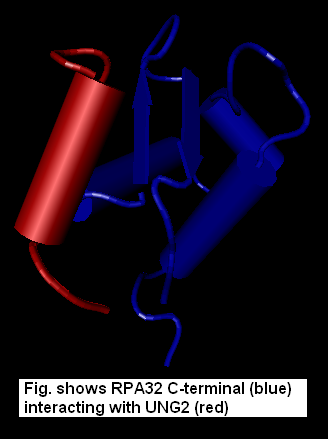
2. 1DPU – RPA32C interacting with UNG2 (homologous to XPA).
3. 1XPA – RPA binding domain of XPA. (Top)
XPA
interacts with RPA32C domain (domain in RPA70 is not clear), whose tertiary
structure has been determined.
Please
click on the links below to view:
1.
RPA32C – Figure obtained through VMD. (or check 1DPU
in PDB)
2.
RPA70(181-432) – Figure obtained
through VMD. (or check 1FGU
in PDB)